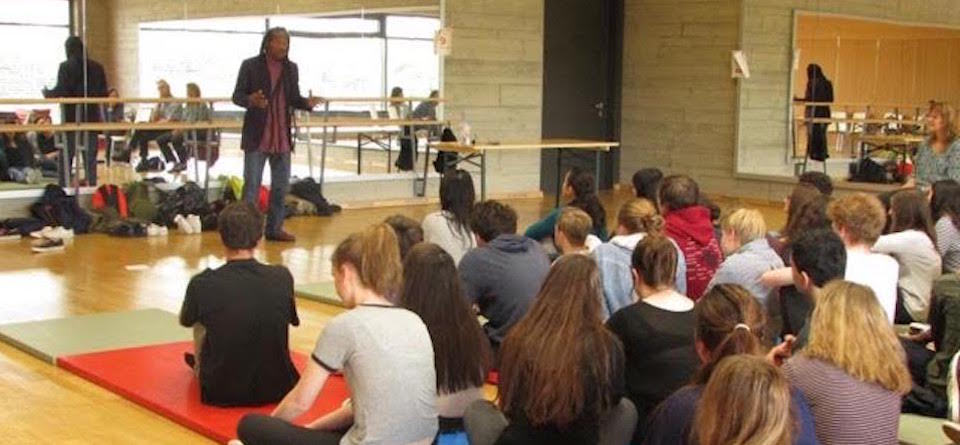
The well-known English poet Benjamin Zephaniah visited our School for two days recently, giving performances to groups of EN section pupils from nursery to S6!
This exceptional event (no EN author has ever visited Lux2 before) was organised by Mots de Zaza and a EN secondary teacher. APEEEL2 is proud to have helped Mots de Zaza by co-financing this initiative alongside the School.
You can read here an article published in the Wort.
Biography
Benjamin Obadiah Iqbal Zephaniah was born and raised in Birmingham, England. After having dropped out of full-time education at the age of 13, he pursued his passion for poetry and went on to establish himself as a poet raising his voice over both local and international issues.
His poetry is significantly influenced by the Jamaican culture and is characterized by political, radical, as well as all sorts of topical elements. There is an element of musicality to his poetry which is both innovative and highly idiosyncratic.
At the age of 22, his first book ‘Pen Rhythm’ was published in London and at the same time, he began attracting the interest of mainstream publishers, after having introduced Dub (Reggae) Poetry in the British poetry scene. His performances of his poetry were highly influential, particularly those which accompanied demonstrations of some of the most popular movements of the early Eighties. His main purpose was to reach people who were not were not readers!
As a strong believer in the importance of the oral culture, he performed, in the early nineties, on almost every continent while his book publications reached record sales in Britain. Nelson Mandela, for whom Zephaniah recorded a musical tribute, was one of his biggest fans.
He has recently published a music album, ‘Naked’, which includes a mixture of Jazz, Reggae, Hip Hop, Rock and house music.
Benjamin Zephaniah has also become an avid writer of books for children and teenagers, expressing his views on veganism and other issues and inspiring many young writers. His first book of poetry for children ‘Talking Turkeys’ achieved immediately popularity.
Last but not least, the poet collaborates with many human rights groups, animal rights groups and other political organisations and continues working throughout Asia, South America and Africa.